Key takeaways
- STABURAGS is a long-established Kluber family of rolling and plain bearing greases, known for load capacity and water resistance.
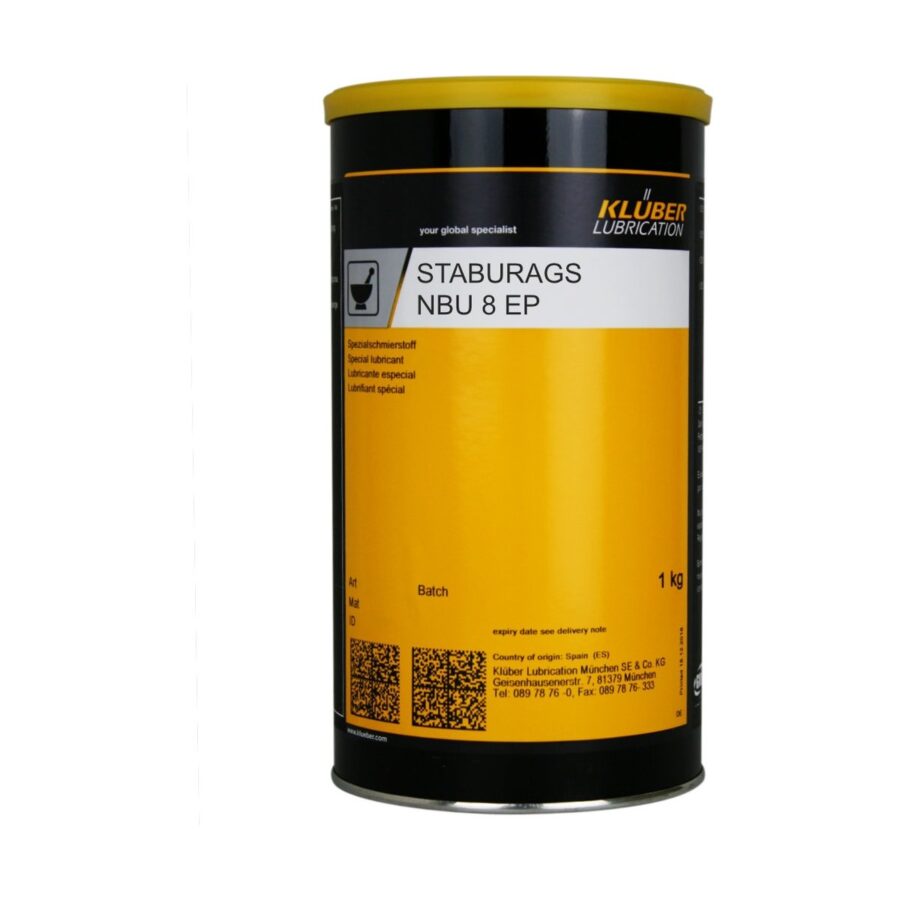
- NBU 8 EP is the heavy-load, extreme-pressure grade for steel, cement, mining and paper equipment.
- The NBU 12 family covers general rolling and plain bearings, with variants for specific needs.
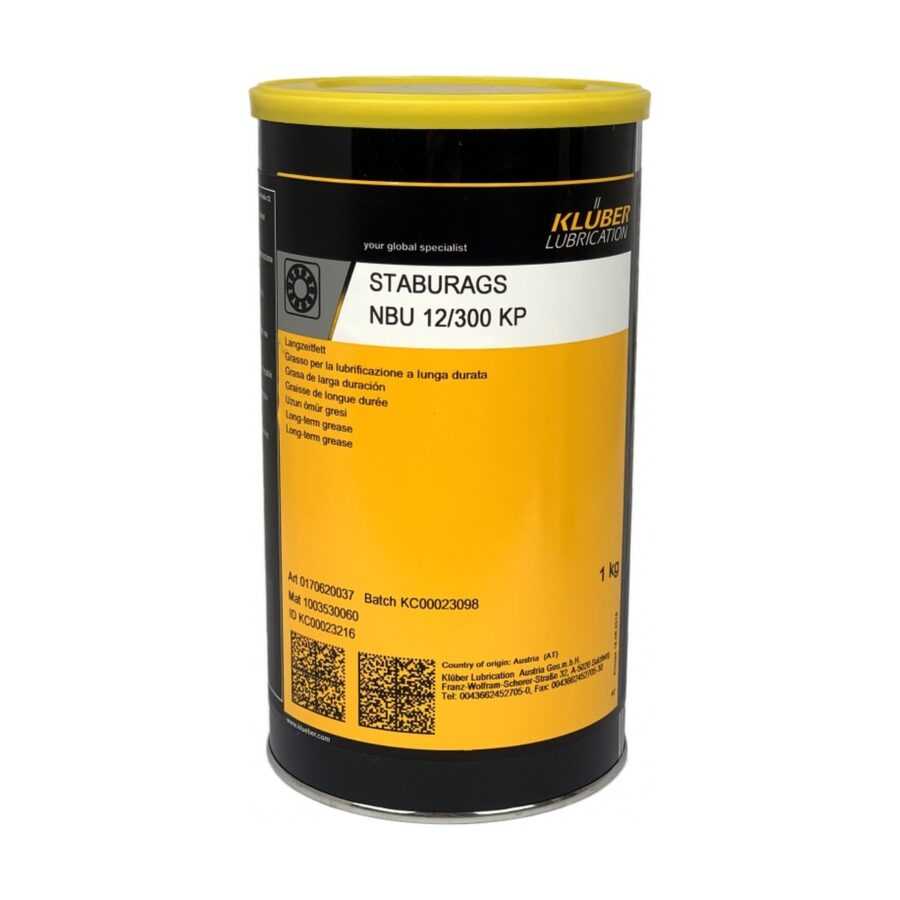
- NBU 12/300 KP is designed for long-term lubrication, including drafting equipment in spinning machines.
- Check temperature range, base-oil viscosity and compatibility on each data sheet before choosing or switching.
STABURAGS greases have been used in heavy industry for decades. Steel mills, cement plants, paper mills, textile mills and mining operations use them for rolling and plain bearings that carry high loads, see water or need long-term lubrication. Many STABURAGS grades are based on mineral oil with a barium complex soap thickener, which gives good adhesion, water resistance and load capacity. This guide covers the STABURAGS grades in our catalogue, what each is designed for and how to choose and use them.
STABURAGS grades in our catalogue
| Grade | Positioning (from product data) | Packs we list |
|---|---|---|
| STABURAGS NBU 8 EP | Rolling-bearing high-pressure grease for heavily loaded bearings | 400 g, 1 kg, 25 kg |
| STABURAGS NBU 12 | Bearing grease; wear-resistant lubricating grease | 50 g, 400 g, 1 kg, 25 kg |
| STABURAGS NBU 12 K | Rolling and plain bearing grease | 400 g, 1 kg, 25 kg |
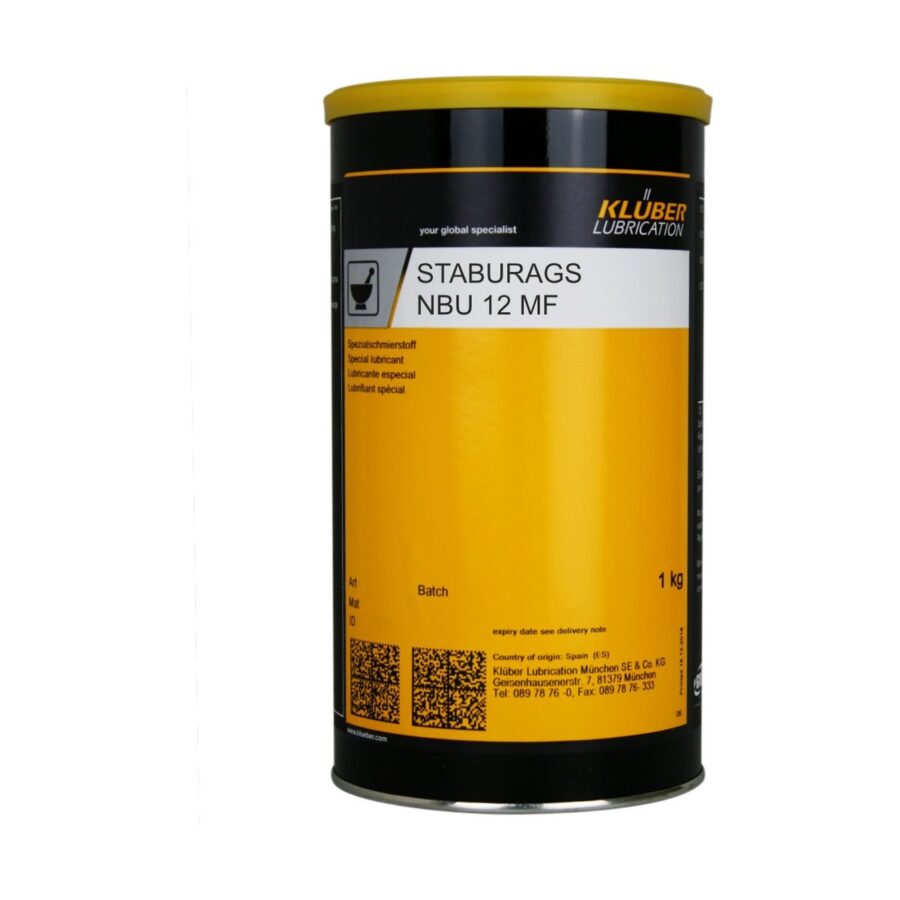
| STABURAGS NBU 12 MF | High-performance grease | 400 g, 1 kg, 25 kg |
| STABURAGS NBU 12/300 KP | Long-term rolling and plain bearing grease; mineral oil with barium complex soap; good corrosion protection and water resistance | 400 g, 1 kg, 25 kg |
| STABURAGS NBU 30, NBU 30 PTM | Lubricating greases with high resistance | 1 kg, 1.2 kg |
| STABURAGS NBU 4 | Rolling bearing grease | 400 g, 1 kg, 25 kg |
Why barium complex greases?
Barium complex thickeners are less common than lithium, but they have properties that suit heavy industry: good adhesion to metal surfaces, high resistance to water and steam, good mechanical stability, and a relatively high dropping point. Greases of this type stay in place in bearings exposed to water sprays, condensation and vibration, which is why they are popular in steel mills, paper machines and wet processes. As with any thickener, compatibility with other greases must be checked before mixing.
STABURAGS NBU 8 EP: heavy loads
NBU 8 EP is the extreme-pressure grade of the family, designed for heavily loaded rolling bearings. Typical applications include roll-neck bearings and other heavily loaded bearings in steel mills, crusher and mill bearings in cement and mining, press bearings, and bearings in paper machines. Its EP additives protect surfaces under shock loads and boundary lubrication. For slow, heavily loaded bearings, check that the base-oil viscosity on the data sheet is high enough for the speed and temperature.
The NBU 12 family: general bearings
STABURAGS NBU 12 is a wear-resistant grease for rolling and plain bearings. The K and MF variants are designed for specific needs, such as different consistencies or performance levels, according to their data sheets. The family suits general industrial rolling and plain bearings, especially where water exposure and wear resistance matter. Compare the data sheets to choose between them.
STABURAGS NBU 12/300 KP: long-term lubrication
According to its product data, STABURAGS NBU 12/300 KP is used for long-term and lifetime lubrication of drafting equipment in spinning machines, tension and eccentric rollers, cardan shafts, and rolling bearings in fans and ventilation systems. It is a common choice in textile mills, where top rollers and drafting units are lubricated for long periods. See our textile industry page and textile mill lubrication guide.
STABURAGS NBU 4 and NBU 30
STABURAGS NBU 4 is a rolling bearing grease, and the NBU 30 grades are lubricating greases with high resistance, according to their product data. Check the data sheets for the applications and limits of each.
Base-oil viscosity and heavy loads
For heavily loaded bearings, the base-oil viscosity of the grease matters more than the thickener. The oil in the grease forms the actual lubricating film between rolling elements and raceways. If the viscosity at operating temperature is too low for the speed and load, the film is too thin and metal contact occurs, even with EP additives. Bearing makers publish methods to calculate the minimum required viscosity from bearing size and speed; slow, large, heavily loaded bearings need high viscosity, often several hundred mm²/s at 40 °C. Compare the base-oil viscosity on the STABURAGS data sheets with the required value for each bearing, especially in hot conditions where viscosity drops.
Quick selection table
| Application | Usual starting point |
|---|---|
| Heavily loaded, shock-loaded bearings (steel, cement, mining) | STABURAGS NBU 8 EP |
| General rolling and plain bearings with water exposure | STABURAGS NBU 12 family |
| Textile drafting rollers, tension rollers, long-term fills | STABURAGS NBU 12/300 KP |
| Fans and ventilation bearings | STABURAGS NBU 12/300 KP or NBU 12 |
| Applications needing special resistance | STABURAGS NBU 30 grades, per data sheet |
How do you choose a grade?
- Check the equipment maker’s recommendation; many European machines specify STABURAGS grades by name.
- Assess load: heavy or shock loads point to NBU 8 EP.
- Check the operating temperature range against the data sheet.
- Check base-oil viscosity for the bearing speed and temperature.
- Consider water, steam and contamination exposure.
- Check compatibility with the grease currently in use.
Relubrication and application
For heavily loaded bearings in dirty or wet environments, regular relubrication flushes out contaminated grease and keeps seals full. Use the bearing formula (0.005 × D × B grams) as a starting point and adjust intervals by temperature, speed and contamination. In very dusty plants, more frequent relubrication with smaller amounts helps keep contaminants out. See bearing relubrication amounts and protecting bearings from dust and sand.
Paper, pulp and wet processes
Paper machines, pulp lines and other wet processes expose bearings to water, steam and chemicals for long periods. Grease in these bearings must resist washout, protect against corrosion and keep seals full. STABURAGS greases are widely used here because of their water resistance and adhesion. Combine them with good sealing and regular relubrication.
Compatibility and switching
Barium complex greases may not be compatible with lithium, polyurea or other greases. When changing to or from a STABURAGS grade, clean out the bearing where possible. Where that is not practical, purge thoroughly with the new grease and shorten the next interval. Check with the manufacturer if in doubt. See grease compatibility.
Storage and handling
Store STABURAGS greases in closed containers indoors, away from heat and moisture. In hot warehouses, keep stock away from roofs and walls exposed to the sun. Use clean tools to take grease from tins and buckets, and close them immediately. Use older stock first.
STABURAGS in GCC heavy industry
Steel mills, aluminium smelters, cement plants and quarries in the GCC combine high loads, heat, dust and, in some areas, water sprays or high humidity near the coast. Barium complex greases suit many of these conditions because they adhere well and resist washout. In dusty plants, focus on sealing and regular purging with fresh grease; in wet areas, focus on water resistance and corrosion protection. Check the upper temperature limit carefully for bearings near furnaces and kilns, where a PFPE or polyurea grease may be the better choice.
What are the signs a grease is not coping?
- Grease purged from seals is dark, hard or contains visible particles.
- Grease looks milky or soft, indicating water contamination.
- Housing temperatures rise steadily between relubrication intervals.
- Vibration or noise increases.
- Rust or fretting marks appear on shafts and housings during inspections.
A worked example: a steel rolling mill
A steel rolling mill in the GCC sees repeated failures in heavily loaded bearings exposed to cooling water sprays. The general-purpose lithium grease in use washes out and the bearings show water damage. The mill switches the affected bearings to STABURAGS NBU 8 EP after cleaning them out, increases relubrication frequency in the wettest zone, and improves the seals. Bearing condition at the next shutdown inspection is much better, and failures between shutdowns fall.
What are the most common mistakes?
- Mixing STABURAGS with lithium greases without checking compatibility.
- Using a general-purpose grease in heavily loaded, wet bearings.
- Choosing NBU 8 EP for high-speed bearings without checking the speed limit.
- Over-greasing fan bearings.
- Ignoring seals: even the best grease washes out of damaged seals.
Frequently asked questions
Are STABURAGS greases water resistant?
The product data for STABURAGS NBU 12/300 KP states it is resistant to water and protects reliably against corrosion. Check each grade’s data sheet.
Which STABURAGS grade for spinning machines?
STABURAGS NBU 12/300 KP is designed for drafting equipment in spinning machines, according to its product data.
Which grade for heavily loaded steel mill bearings?
STABURAGS NBU 8 EP is the extreme-pressure grade designed for heavily loaded rolling bearings.
Can STABURAGS be mixed with lithium grease?
Barium complex and lithium greases may be incompatible. Clean out or purge thoroughly, and check with the manufacturer.
What thickener does STABURAGS use?
Many STABURAGS grades use a barium complex soap with mineral oil. Check each grade’s data sheet.
Are STABURAGS greases suitable for high speeds?
Speed limits differ by grade. Check the speed factor on each data sheet; for very high-speed bearings, a spindle grease such as ISOFLEX may be more suitable.
Conclusion
STABURAGS greases are proven performers for heavily loaded, wet and long-term bearing applications in heavy industry. Choose NBU 8 EP for heavy loads, the NBU 12 family for general bearings and NBU 12/300 KP for long-term lubrication such as spinning machines. Check data sheets, handle compatibility carefully and relubricate correctly. See all STABURAGS products and our extreme-pressure greases.
Need help applying this to your plant? Send us the equipment details or the product you use now and we will recommend a suitable Kluber or Mobil grade: request a quote and we reply within one business day.