Key takeaways
- Relubrication quantity depends mainly on bearing size; bearing makers give simple formulas.
- Relubrication interval depends on bearing type, speed, temperature, load and contamination.
- Grease life roughly halves for every 15 °C rise above a reference temperature (a common rule of thumb).
- Calibrate grease guns: “three pumps” means very different amounts on different guns.
- Over-greasing is as harmful as under-greasing, especially in electric motors.
“Give it a few pumps” is still the most common relubrication instruction in many plants, and one of the most common causes of bearing failure. Bearings need the right amount of grease at the right interval, and both depend on the bearing and how it runs. This guide explains how quantity and interval are determined, what goes wrong when they are not, and how to build a routine your team can follow.
Why does the right amount of grease matter?
A rolling bearing needs only a small amount of grease to form its lubricating film. Fresh grease replaces aged grease and helps flush out contaminants. Too little, or too rarely, and the film breaks down; too much, and the bearing churns the excess, generates heat and pushes grease past its seals. Both shorten bearing life.
How much grease should you add at each relubrication?
Bearing manufacturers publish simple formulas based on bearing dimensions. A widely used rule for side relubrication is:
Grease quantity (g) ≈ 0.005 × D × B, where D is the bearing outside diameter (mm) and B its width (mm).
For example, a bearing with D = 100 mm and B = 25 mm needs about 0.005 × 100 × 25 = 12.5 g per relubrication. Some manufacturers use slightly different factors depending on where the grease enters (through the side or through the outer ring), so check the bearing maker’s guidance for your bearing type.
Why should you calibrate your grease guns?
A grease gun stroke can deliver anything from under 1 g to several grams, depending on the gun and how it is used. To turn grams into strokes:
- Dispense ten full strokes onto a scale.
- Divide the weight by ten to get grams per stroke.
- Write the value on the gun.
- Express each point’s quantity in strokes for that gun.
How often should you relubricate a bearing?
Bearing makers provide charts that give a base relubrication interval from the bearing type, size and speed (the speed factor n × dm). That base interval assumes a reference temperature and clean conditions, and is then adjusted:
| Factor | Effect on interval |
|---|---|
| Operating temperature above reference | Shorter: as a rule of thumb, interval halves for every 15 °C rise above about 70 °C |
| Vertical shaft | Shorter, as grease tends to leave the bearing |
| Vibration or shock loads | Shorter |
| Dust, dirt or moisture | Shorter, to purge contaminants |
| Heavy load | Shorter |
| Synthetic long-life grease | Can be longer, within the grease maker’s guidance |
In the GCC, where many bearings run hotter than their design temperature in summer, the temperature correction is often the biggest factor. A bearing that is fine with monthly relubrication in winter may need it every two weeks in summer.
What are the signs that quantities or intervals are wrong?
| Symptom | Possible cause |
|---|---|
| Temperature rises after greasing and stays high | Too much grease, or no relief path |
| Grease leaking from seals | Over-greasing or incompatible grease |
| Dry, discoloured or hardened grease in the bearing | Interval too long or temperature too high |
| Noise or rising vibration between relubrications | Interval too long, wrong grease, contamination |
| Dirty grease coming out of seals | Contamination; shorten interval or improve sealing |
Over-greasing: the hidden danger
Over-greasing causes churning, heat and seal damage, and in electric motors it can push grease into the windings. A short temperature rise after greasing is normal and should settle within a few hours as excess grease escapes; if it does not, there is too much grease or nowhere for it to go. See over-greasing: signs, causes and prevention.
Building a practical relubrication routine
- List every greased point with the grease, quantity (g and strokes) and interval.
- Calibrate and label each grease gun.
- Clean grease fittings before greasing.
- Open relief plugs where fitted; run the bearing so excess grease is expelled; close them afterwards.
- Record each relubrication (date, quantity, observations).
- Use automatic single-point lubricators on hard-to-reach or critical points.
- Review intervals using bearing temperature, vibration or ultrasound.
Our guide on building a lubrication schedule shows how to organise this into routes.
Using condition monitoring to fine-tune
Ultrasound listening devices let technicians hear when a bearing needs grease: the friction noise drops as fresh grease reaches the contact, and greasing can stop at that point. Temperature trends and vibration analysis also show whether intervals are right. Many plants use these tools on critical bearings to move from fixed schedules to condition-based relubrication.
Relubrication methods compared
| Method | Best for | Advantages | Watch out for |
|---|---|---|---|
| Manual grease gun | Most plants, accessible points | Low cost, flexible | Quantity varies; depends on discipline and records |
| Single-point automatic lubricator | Hard-to-reach, critical or hazardous points | Small, constant doses; fewer visits | Correct setting; check it is discharging |
| Centralised (single-line, progressive, dual-line) | Many points on one machine or line | Consistent delivery; automation | Pumpable grease grade; blocked lines |
| Oil mist / oil-air | Very high-speed spindles, some process plants | Precise oil delivery, cooling | Specialist equipment |
Most plants combine methods: manual greasing for the majority of points, automatic lubricators for difficult points, and centralised systems on large machines such as presses, mills and conveyors.
Relubrication and grease choice go together
Intervals are only as good as the grease. A grease whose upper service temperature is close to the bearing’s running temperature ages quickly and needs very short intervals; a synthetic or high-temperature grease in the same bearing can run much longer between relubrications. When intervals become impractically short, change the grease rather than greasing more often.
How do GCC conditions change relubrication?
Three local factors change the numbers. Heat: bearings in outdoor equipment, hot plant rooms and near furnaces often run well above the reference temperature in bearing makers’ charts, so intervals must be shortened, especially in summer. Dust and sand: shorter intervals help fresh grease purge contaminants from seals in quarries, cement plants and construction equipment. Humidity on the coast: condensation and salt air increase corrosion risk, so water-resistant greases and regular relubrication protect bearings in ports and coastal plants.
Worked example: from bearing to schedule
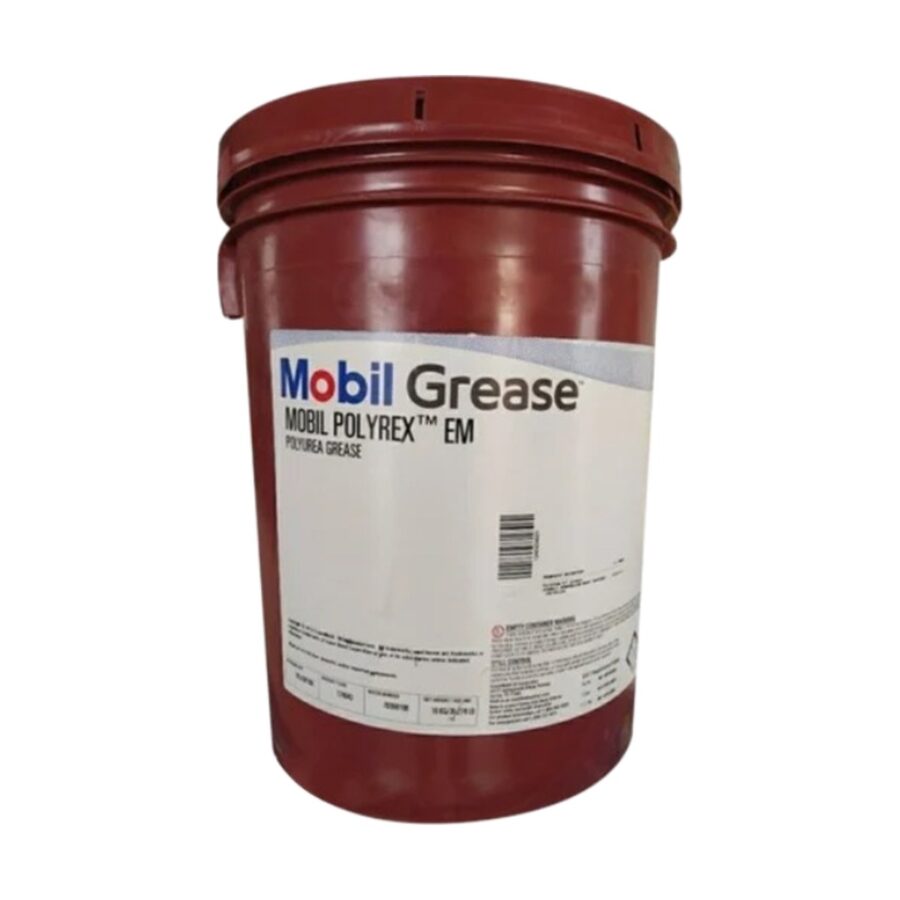
Take a fan bearing with outside diameter D = 140 mm and width B = 33 mm. The quantity is about 0.005 × 140 × 33 ≈ 23 g. The grease gun used on that route delivers 1.5 g per stroke, so the instruction becomes 15 strokes. The bearing maker’s chart gives a base interval of about 2,000 operating hours for this size and speed at the reference temperature. The fan runs at about 85 °C in summer, 15 °C above the 70 °C reference, so the interval is halved to about 1,000 hours, roughly six weeks of continuous running. The lubrication schedule therefore lists: “Fan F-07, drive-end bearing, Mobil Polyrex EM, 23 g (15 strokes, gun G-3), every 6 weeks; open relief plug.”
Once this is set, the team monitors temperature and adjusts if the bearing runs hotter or cooler than expected.
Learn from the purged grease
The old grease that comes out of a relief plug or seal during relubrication is a free diagnostic sample. Look at it every time:
| What you see | What it suggests |
|---|---|
| Clean, similar colour to new grease | Interval and quantity are about right |
| Dark, hard or crusty | Interval too long or temperature too high; consider a higher-temperature grease |
| Gritty or dirty | Contamination; improve sealing or shorten the interval |
| Milky or watery | Water ingress; check seals and use a water-resistant grease |
| Shiny metal particles | Bearing wear; investigate with vibration analysis |
| Very soft and runny | Possible incompatibility with a previous grease, or excessive heat |
Recording these observations in the lubrication log turns routine greasing into an early-warning system.
Special cases
- Electric motors: follow the nameplate quantity and interval; never over-grease.
- Sealed bearings: lubricated for life; do not attempt to relubricate.
- High-speed spindles: very small quantities and a running-in procedure.
- Centralised systems: set outputs to deliver the calculated quantity per point.
What are the most common mistakes?
- Using “a few pumps” without knowing grams per stroke.
- Greasing every bearing the same amount regardless of size.
- Ignoring temperature when setting intervals.
- Leaving relief plugs closed while greasing.
- Two technicians greasing the same point without records.
Frequently asked questions
Should I grease a bearing until grease comes out of the seal?
Not with sealed or shielded bearings, and not without a relief path. Excess grease must have somewhere to go. Follow the equipment maker’s instructions.
How often should electric motor bearings be greased?
Follow the motor nameplate or manual, which gives the quantity and interval for each bearing.
Does synthetic grease allow longer intervals?
Often yes, especially at high temperatures, within the grease maker’s guidance.
What is the 0.005 × D × B rule?
A common bearing-maker formula for side relubrication quantity in grams, using outside diameter and width in millimetres.
Should intervals change in summer?
For hot bearings, yes. Higher temperatures shorten grease life, so shorter intervals in summer are often needed in the GCC.
Can I use the same quantity for every bearing on a route?
No. Quantity depends on bearing size, so a small motor bearing and a large fan bearing need very different amounts. Calculate each point and write it on the schedule.
Conclusion
Correct relubrication is about the right quantity at the right interval, adjusted for temperature and conditions. Calculate quantities from bearing size, calibrate grease guns, adjust intervals for heat and contamination, and record what you do. Add condition monitoring for critical points, and most lubrication-related bearing failures disappear.
Need help applying this to your plant? Send us the equipment details or the product you use now and we will recommend a suitable Kluber or Mobil grade: request a quote and we reply within one business day.