Key takeaways
- The base oil, not the thickener, forms the lubricating film between rolling elements and raceways.
- Base-oil viscosity at operating temperature decides whether that film is thick enough to prevent metal contact.
- Slow, heavily loaded bearings need high viscosity; fast, lightly loaded bearings need low viscosity.
- Viscosity falls sharply as temperature rises, so always judge it at the real operating temperature.
- Two greases with the same NLGI grade can have completely different base-oil viscosities.
When two greases with the same NLGI grade behave very differently in the same bearing, the reason is very often the base-oil viscosity. It is the single most important number on a grease data sheet for bearing life, yet many buyers and even maintenance engineers never look at it. This guide explains what base-oil viscosity does, how to work out what your bearing needs, and how to use the figure to choose between products.
What does the base oil in a grease actually do?
A lubricating grease is mostly oil, held in a thickener. As the bearing runs, the thickener releases small amounts of oil into the contact between the rolling elements and the raceways. There, the oil forms an extremely thin film, often well under a micrometre thick, that separates the metal surfaces under very high contact pressure. This is called elastohydrodynamic (EHD) lubrication.
Whether that film is thick enough depends mainly on three things: the oil’s viscosity at the operating temperature, the speed of the rolling surfaces and the load. Higher viscosity and higher speed build a thicker film; very high load compresses it. If the film becomes thinner than the surface roughness of the parts, the peaks of the metal surfaces touch, and wear and surface fatigue begin.
Viscosity, speed and load: the basic rules
| Condition | Base-oil viscosity needed | Reason |
|---|---|---|
| Slow speed, heavy load | High | Slow motion builds a thin film; a viscous oil compensates |
| Normal speed and load | Medium | Balanced film thickness and friction |
| High speed, light load | Low | A thick oil would churn, create friction and overheat the bearing |
| Oscillating or very slow motion | High, often with solid lubricants | Little film is formed by motion alone |
| High operating temperature | Higher at 40 °C | Viscosity drops as temperature rises |
| Very low start-up temperature | Not excessive | A stiff grease can starve the bearing at start-up |
How does temperature change viscosity?
Viscosity falls quickly as oil gets hotter. An oil that is perfectly adequate at 40 °C can be too thin at 90 °C. That is why data sheets give the base-oil viscosity at 40 °C and usually at 100 °C. The relationship between the two is expressed as the viscosity index (VI): the higher the VI, the less the viscosity changes with temperature. Synthetic base oils such as PAO and esters generally have higher VIs than mineral oils, which is one reason they perform well over wide temperature ranges.
In GCC conditions, where bearings in outdoor equipment and hot plant rooms can run far above their design temperatures in summer, checking viscosity at the real operating temperature is essential.
How do you estimate the viscosity your bearing needs?
Bearing manufacturers publish methods and charts to calculate the minimum required viscosity (often written ν₁) for a bearing, based on its mean diameter and speed. You then compare it with the actual viscosity of the lubricant at operating temperature (ν). The ratio κ = ν ÷ ν₁ (kappa) is used in bearing life calculations:
- κ below about 1: the film is thinner than ideal; wear and reduced life are likely unless EP or anti-wear additives help.
- κ between about 1 and 4: generally good lubrication conditions.
- κ well above 4: little extra benefit, and very viscous oils may increase friction and heat at speed.
You do not need to do these calculations for every bearing. But for critical, slow, heavily loaded or hot bearings, a quick check against the bearing maker’s guidance avoids choosing a grease whose base oil is simply too thin.
Worked example
A slow conveyor drive bearing in a quarry runs at about 60 rpm under heavy load at 70 °C. The bearing maker’s chart shows that, at this speed and size, the bearing needs a fairly high viscosity at operating temperature. A general-purpose grease with a mineral base oil of around 100 mm²/s at 40 °C may be too thin at 70 °C. A grease with a much higher base-oil viscosity, such as a heavy-duty EP grease or a synthetic grease like Mobilith SHC 460, would give a far better film and a much longer bearing life.
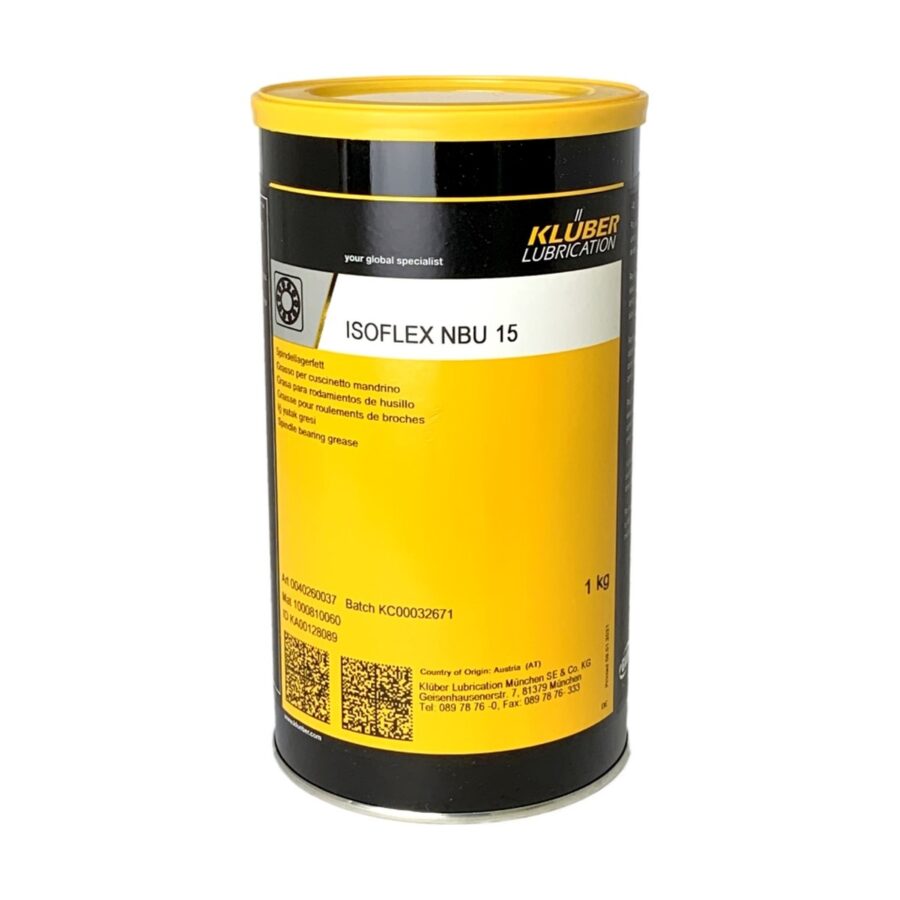
Now take a machine-tool spindle running at very high speed with a light load. Here a high-viscosity grease would churn and overheat the bearing. A spindle grease with a low base-oil viscosity, such as Kluber ISOFLEX NBU 15, is the right choice.
Examples from our range
| Product | Base-oil viscosity level | Typical application |
|---|---|---|
| Kluber ISOFLEX NBU 15 | Low | High-speed spindle bearings |
| Mobilith SHC 100 | Low to medium (synthetic) | Faster bearings, wide temperature range |
| Mobilux EP 2 | Medium | General industrial bearings |
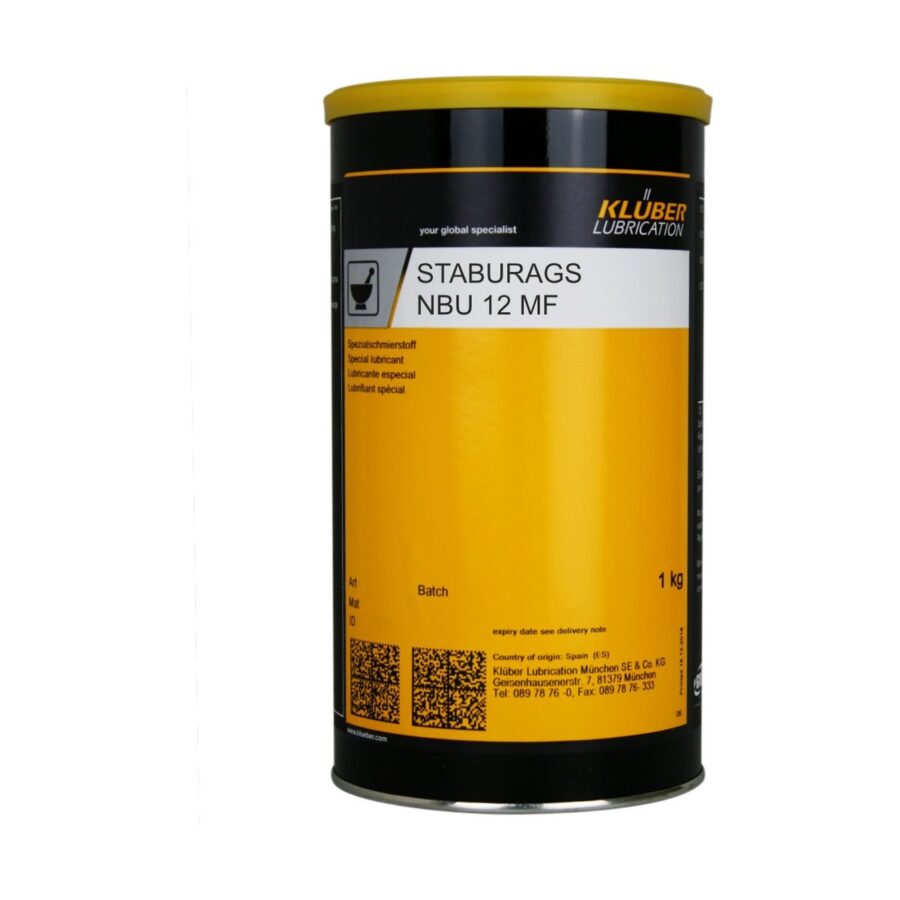
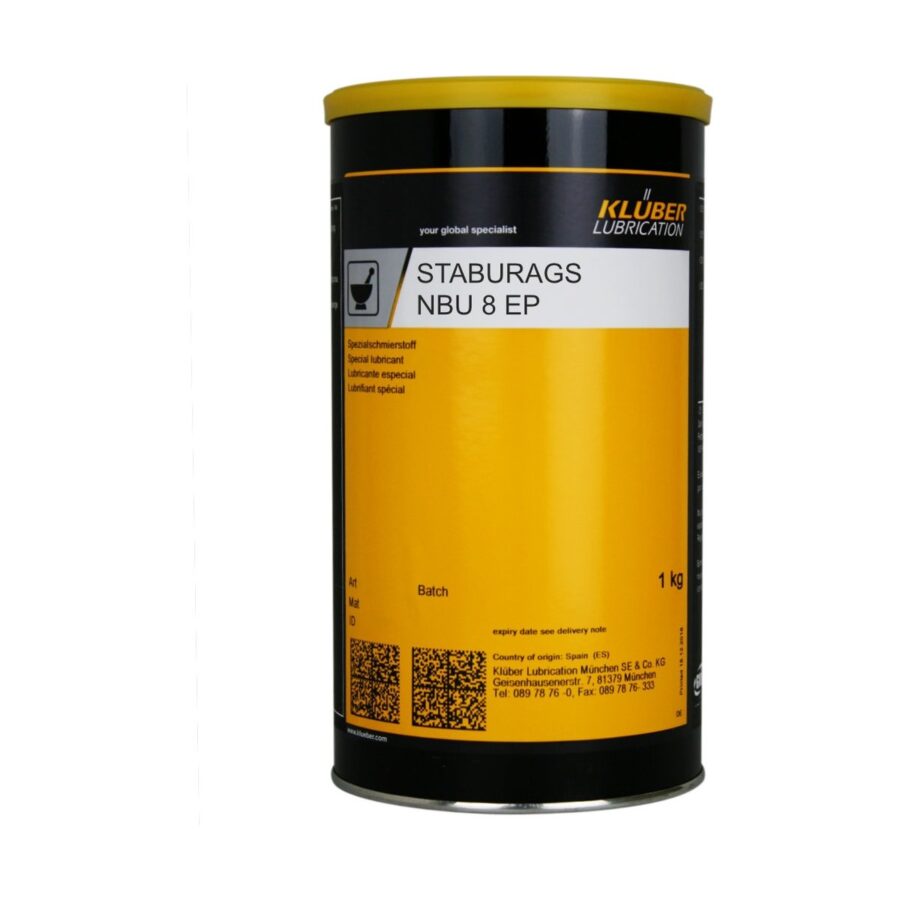
| Kluber STABURAGS NBU 8 EP | High | Heavily loaded rolling bearings |
| Mobilith SHC 460 | High (synthetic) | Slow, heavily loaded, hot bearings |
Exact viscosity values are listed on each product’s technical data sheet; download them from our TDS & SDS library or the product pages.
Where do you find base-oil viscosity on a data sheet?
Look for “kinematic viscosity of the base oil” (Kluber) or “viscosity of base oil, mm²/s at 40 °C” (Mobil). Both are measured according to standards such as DIN 51562 or ASTM D445. Compare the value with what your bearing needs, not just with the grease you used before. Our guide on how to read a lubricant data sheet explains the other values on the sheet.
Base-oil viscosity and speed rating
Grease data sheets also state a speed factor (n × dm) limit. This is linked to base-oil viscosity: low-viscosity greases tolerate higher speeds. If a grease is used above its speed rating, the bearing runs hot, the grease ages quickly and the bearing can fail even though the viscosity looked adequate on paper.
Synthetic vs mineral base oils
Synthetic base oils do not automatically have higher or lower viscosity, but they keep their viscosity more stable across temperature and resist oxidation better. That means a synthetic grease can provide a more consistent film from cold start to hot running and last longer at temperature. For hot GCC applications this is often the deciding advantage.
How does base-oil viscosity affect grease life?
Viscosity also affects how long a grease lasts. A grease whose base oil is too thin for the bearing runs with more metal contact, which raises temperature and accelerates oxidation of the oil and thickener. A grease whose base oil is far too thick for the speed churns and generates heat for a different reason. In both cases, higher temperature shortens grease life. Getting the viscosity right therefore extends not only bearing life but also relubrication intervals.
Questions to ask your supplier
- What is the base-oil viscosity at 40 °C and 100 °C?
- What is the base-oil type (mineral, PAO, ester, PFPE)?
- What speed factor (n × dm) is the grease rated for?
- Is there an alternative grade with a higher or lower base-oil viscosity in the same family?
- Does the grease contain EP additives or solid lubricants for low-film conditions?
If you are unsure, send us your bearing details through our request a quote form and we will suggest a grease with a suitable base-oil viscosity.
What are the most common mistakes?
- Comparing greases on NLGI grade only.
- Using a low-viscosity general-purpose grease in slow, heavily loaded bearings.
- Using a heavy, high-viscosity grease in high-speed bearings, causing heat.
- Checking viscosity at 40 °C but ignoring the real operating temperature.
- Assuming a “premium” grease automatically has the right viscosity.
How do you put this into practice?
- List your critical bearings with speed, size, load and operating temperature.
- Use the bearing maker’s method to estimate the viscosity each one needs.
- Check the base-oil viscosity of your current grease at operating temperature.
- Where the current grease is too thin or too thick, choose a grease with a suitable base oil.
- Group bearings with similar requirements to keep the number of greases low.
Frequently asked questions
Does a higher base-oil viscosity always protect better?
No. Too high a viscosity at high speed creates friction and heat, and can starve the bearing at low temperatures. Match the viscosity to the speed and temperature.
Is base-oil viscosity the same as NLGI grade?
No. NLGI describes how stiff the grease is; base-oil viscosity describes the oil inside it. They are independent.
Where do I find the base-oil viscosity?
On the technical data sheet, usually at 40 °C and 100 °C, in mm²/s.
Can EP additives make up for low viscosity?
They reduce wear when the film breaks down, but they do not replace an adequate film. For slow, heavily loaded bearings, choose an adequate viscosity first.
Why do synthetic greases help at high temperature?
Their base oils keep viscosity more stable and resist oxidation, so the film stays adequate and the grease lasts longer.
Conclusion
Base-oil viscosity is the most important property of a grease for bearing life. Match it to the speed, load and operating temperature of each bearing, use the bearing maker’s guidance for critical points, and read the viscosity on the data sheet rather than relying on the NLGI grade or brand name. Doing so prevents a large share of premature bearing failures.
Need help applying this to your plant? Send us the equipment details or the product you use now and we will recommend a suitable Kluber or Mobil grade: request a quote and we reply within one business day.