Key takeaways
- The technical data sheet (TDS) describes what a lubricant is and how it performs; the safety data sheet (SDS) describes hazards and safe handling.
- For oils, start with type, base oil, ISO VG, viscosity index and the key performance tests.
- For greases, start with base oil, thickener, NLGI grade, base-oil viscosity, temperature range and speed factor.
- Typical values are not specifications: use them to compare, not as guaranteed limits.
- Compare products test by test, using the same test methods.
Every industrial lubricant has a technical data sheet (TDS), sometimes called a product data sheet (PDS), and a safety data sheet (SDS). The TDS tells you what the product is and how it performs; the SDS tells you how to handle it safely. Being able to read a TDS is essential for choosing lubricants, comparing products, checking equivalents and investigating problems. This guide walks through the main sections and numbers.
What is the difference between a TDS and an SDS?
| Technical data sheet (TDS) | Safety data sheet (SDS) | |
|---|---|---|
| Purpose | Product description and performance | Hazards, safe handling, emergency measures |
| Typical contents | Applications, properties, typical values, approvals | 16 standard sections, from identification to regulatory information |
| Who uses it | Engineers, buyers, maintenance | HSE, storekeepers, users, emergency responders |
| Legal status | Commercial document | Required by chemical safety regulations in many countries |
The first section: description and applications
Most data sheets start with a short description of the product, its type and its main applications, followed by features and benefits. This section tells you what the product is designed for: for example, a long-term, high-temperature rolling bearing grease, or a synthetic gear and bearing oil. Check that the intended applications match your use.
How do you read an oil data sheet?
| Property | What it means | Why it matters |
|---|---|---|
| Base oil type | Mineral, PAO, ester, PAG | Temperature range, compatibility |
| ISO VG | Viscosity grade at 40 °C | Must match the equipment requirement |
| Kinematic viscosity at 40 °C and 100 °C | Actual viscosity in mm²/s | Confirms grade and temperature behaviour |
| Viscosity index (VI) | How viscosity changes with temperature | Higher VI = more stable viscosity |
| Pour point | Lowest temperature at which oil flows | Cold starts |
| Flash point | Temperature at which vapours ignite | Safety, volatility |
| FZG scuffing load stage | Gear load-carrying capacity | Gear protection |
| Four-ball wear / EP tests | Anti-wear and EP performance | Protection under load |
| Demulsibility | Water separation | Wet systems, turbines, hydraulics |
| Foam tendency and air release | Foam and entrained air | Hydraulics, gearboxes |
| Rust and copper corrosion tests | Protection of metals | Wet and humid conditions |
| Oxidation tests | Resistance to ageing | Oil life |
How do you read a grease data sheet?
| Property | What it means | Why it matters |
|---|---|---|
| Base oil type | Mineral, PAO, ester, PFPE, silicone | Temperature range, compatibility |
| Thickener type | Lithium, lithium complex, polyurea, calcium sulfonate, barium complex, PTFE | Temperature, water resistance, compatibility |
| NLGI grade | Consistency | Application method, sealing |
| Base-oil viscosity at 40 °C | Thickness of the oil in the grease | Film strength for speed and load |
| Service temperature range | Lower and upper operating limits | Must cover the bearing temperature |
| Dropping point | Temperature at which grease becomes fluid | Indicator only, not a service limit |
| Speed factor (n·dm) | Maximum speed capability | High-speed bearings |
| Four-ball weld load | EP performance | Heavily loaded bearings |
| Water washout / water resistance | Resistance to water | Wet applications |
| Emcor / SKF rust test | Corrosion protection | Humid and wet conditions |
| Oil separation | Oil bleed in storage | Shelf life |
What is the difference between typical values and specifications?
Most data sheets state “typical values” or “typical properties”. These are representative values from production, not guaranteed limits for every batch. Small variations between batches are normal. Use typical values to understand and compare products, not as acceptance limits. Where you need guaranteed limits, ask for a product specification or a certificate of analysis for the batch.
Why do test methods matter?
Each property is measured by a standard test method, such as ASTM, ISO or DIN methods. Two data sheets can report the same property using different methods or conditions, which makes direct comparison misleading. When comparing products, check that the test method and conditions are the same, for example the same temperature and duration for a water washout test.
Approvals and specifications
Data sheets list industry specifications the product meets, such as DIN 51517-3 (CLP gear oils), DIN 51524-2 (HLP hydraulic oils), ISO 12925-1 or ISO 6743 classes, and OEM approvals from equipment makers. They may also show NSF H1 registration for food-grade products. Check that the specification your equipment requires is listed, and note whether the product “meets” a specification or holds a formal “approval”, which is stronger.
Worked example: reading a grease TDS
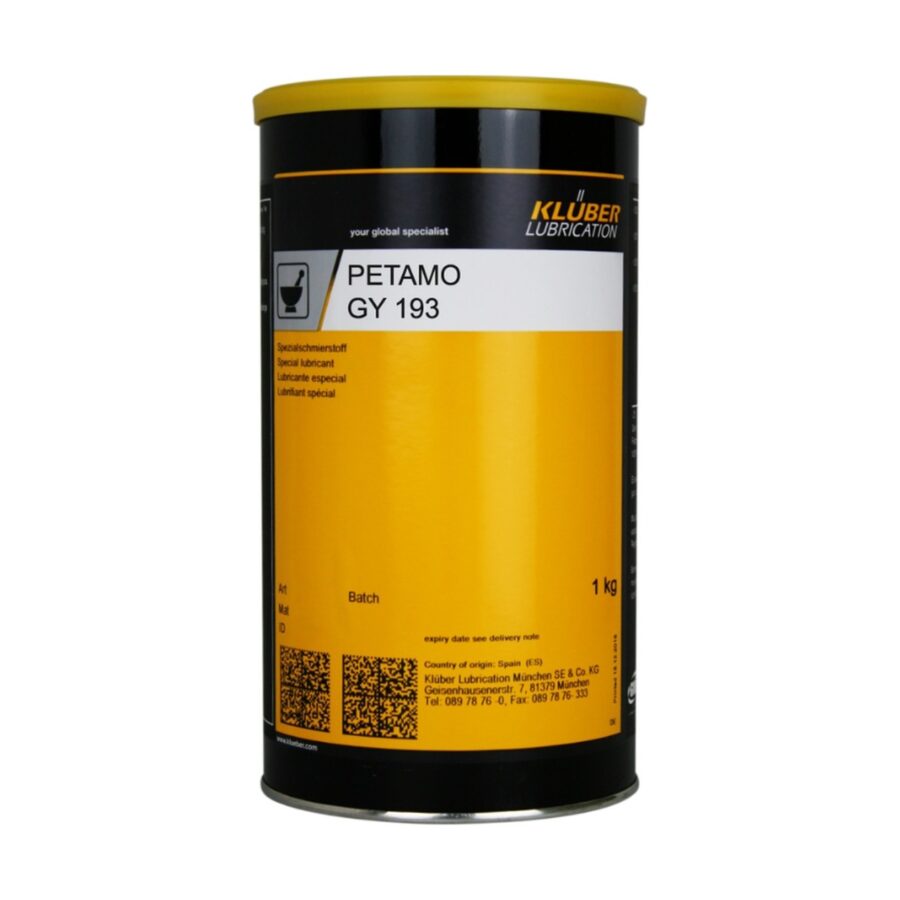
Take PETAMO GY 193 as an example. According to its product data, it is a long-term, high-temperature grease based on ester oil with a polyurea thickener, with a service temperature range of about −20 °C to 180 °C. Reading this, you know it suits hot bearings, that polyurea may be incompatible with lithium greases, and that the upper limit gives margin for a bearing measured at, say, 130 °C. Next you would check the speed factor and base-oil viscosity against the bearing’s needs. See PETAMO greases explained.
How do you compare two products?
- Check the type, base oil and thickener first.
- Compare viscosity (ISO VG or base-oil viscosity) and NLGI grade.
- Compare temperature ranges.
- Compare performance tests, using the same methods.
- Check approvals and registrations.
- Consider compatibility with the current product.
See finding lubricant equivalents safely.
How do you read a safety data sheet?
The SDS follows a standard structure of 16 sections in most countries, based on the Globally Harmonized System (GHS). Key sections for lubricant users include:
| Section | Contents |
|---|---|
| 2. Hazard identification | Classification, pictograms, hazard statements |
| 4. First-aid measures | What to do after skin, eye contact or ingestion |
| 5. Fire-fighting measures | Suitable extinguishing media |
| 6. Accidental release | Spill response |
| 7. Handling and storage | Safe handling and storage conditions |
| 8. Exposure controls / PPE | Gloves, eye protection, ventilation |
| 13. Disposal | How to dispose of waste lubricant |
Keep current SDS for every lubricant on site, in the language required locally, and make them accessible to users and emergency responders.
Using data sheets in daily work
Data sheets are not just for selection. Use them to set oil analysis alarm limits, for example comparing measured viscosity with the new-oil value; to check that relubrication intervals suit the grease’s temperature range; to plan storage using the shelf life and storage temperature guidance; and to investigate failures by comparing operating conditions with the product’s limits. Keep a file of current data sheets for every product in your lubricant list, and link them to the lubrication schedule so technicians can find them easily.
Questions to ask when a data sheet is unclear
- Which test method was used for this property?
- Is this a typical value or a specification limit?
- Does the product hold the approval, or only meet the specification?
- Which grades in the family does this document cover?
- When was the document last updated?
Your supplier or the brand owner should be able to answer these questions. If not, treat the comparison with caution.
A checklist for reviewing any data sheet
Before approving a lubricant for a machine, run through a short review. Does the product type match the application? Does the viscosity or consistency match what the equipment maker specifies? Does the temperature range cover the real operating temperature with a margin? Are the load, speed and water resistance results suitable for the duty? Does the product meet the specifications or approvals the equipment requires? Is it compatible with the lubricant currently in use? Is the document current, and does it cover the exact grade being bought? If the answer to every question is yes, the product is a good candidate. If any answer is no or unclear, ask the supplier before going ahead, and record the decision and the reasons in your lubricant list so the next person does not have to repeat the review.
Units and conversions
Most data sheets use SI units: viscosity in mm²/s (equal to centistokes, cSt), temperature in °C and loads in newtons. Some older or US documents use SUS for viscosity or °F for temperature. Convert before comparing, and be careful with rounding.
Where can you find data sheets?
Brand owners publish data sheets on their websites, and suppliers should provide them with quotes and deliveries. Check that you have the current version, because formulations and documents are updated over time. Each product page in our catalogue links to its TDS and SDS where available, and you can ask us for any document.
Data sheets and food-grade products
For food and beverage applications, the data sheet usually states NSF H1 registration and sometimes ISO 21469, Halal or Kosher status. Check that the registration covers the exact grade, and keep the registration evidence with the data sheet for audits. See NSF H1 vs H2 vs H3.
What are the most common mistakes?
- Treating the dropping point as the maximum service temperature.
- Comparing typical values from different test methods.
- Ignoring base oil and thickener types when comparing.
- Using outdated data sheets.
- Not keeping SDS for every product on site.
Frequently asked questions
What is the difference between a TDS and an SDS?
The TDS describes the product and its performance; the SDS describes hazards and safe handling.
Is the dropping point the maximum temperature?
No. The maximum service temperature is usually well below the dropping point. Use the service temperature range.
Are typical values guaranteed?
No. They are representative values. Ask for a specification or certificate of analysis if you need guaranteed limits.
Where can I get data sheets?
From the brand owner’s website or your supplier. Ask us for any TDS or SDS for products we supply.
Why do two similar products show different test results?
They may be formulated differently, or measured with different methods. Compare using the same methods.
How often are data sheets updated?
Brand owners update them when formulations, approvals or regulations change. Check the date and request the current version periodically.
Conclusion
A data sheet is the most important tool for choosing and comparing lubricants. Read the description first, then check type, base oil, thickener, viscosity, temperature range, performance tests and approvals, and remember that typical values are not specifications. Keep the SDS for safe handling. Browse our TDS and SDS library.
Need help applying this to your plant? Send us the equipment details or the product you use now and we will recommend a suitable Kluber or Mobil grade: request a quote and we reply within one business day.