Key takeaways
- BARRIERTA L 55 is a PFPE (perfluoropolyether) oil grease thickened with PTFE, with very high thermal and chemical stability.
- The number after the slash shows consistency: 55/0 is softest, 55/1 medium, 55/2 firmer.
- It suits very hot bearings, chemical exposure and long intervals; the product data lists NSF H1 registration for the grades stated.
- It must not be mixed with conventional greases: clean bearings completely before switching.
- Its higher price is usually offset by much longer life and fewer failures in hot service.
BARRIERTA L 55 is one of the best-known high-temperature greases in industry. It is based on a perfluoropolyether (PFPE) base oil with a polytetrafluoroethylene (PTFE) thickener, a combination that gives very high thermal and chemical stability. Plants use it where bearings run too hot for mineral or synthetic hydrocarbon greases, where chemicals attack conventional lubricants, and where very long relubrication intervals are needed. This guide explains the grades, applications and how to switch correctly.
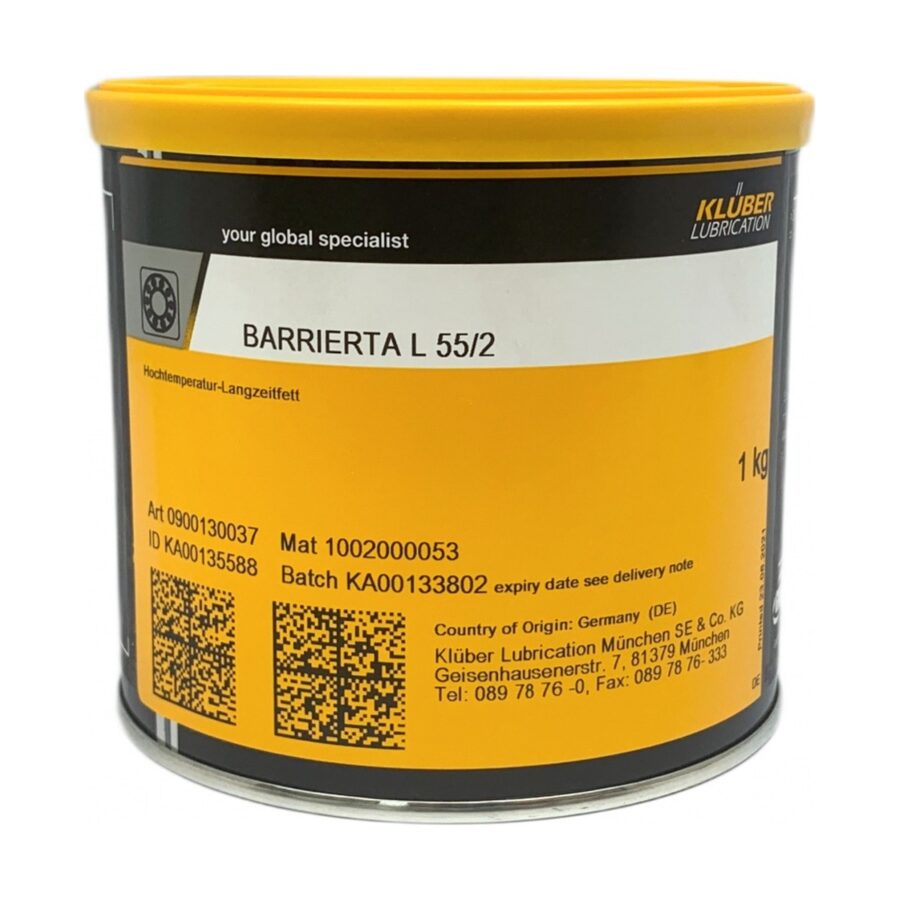
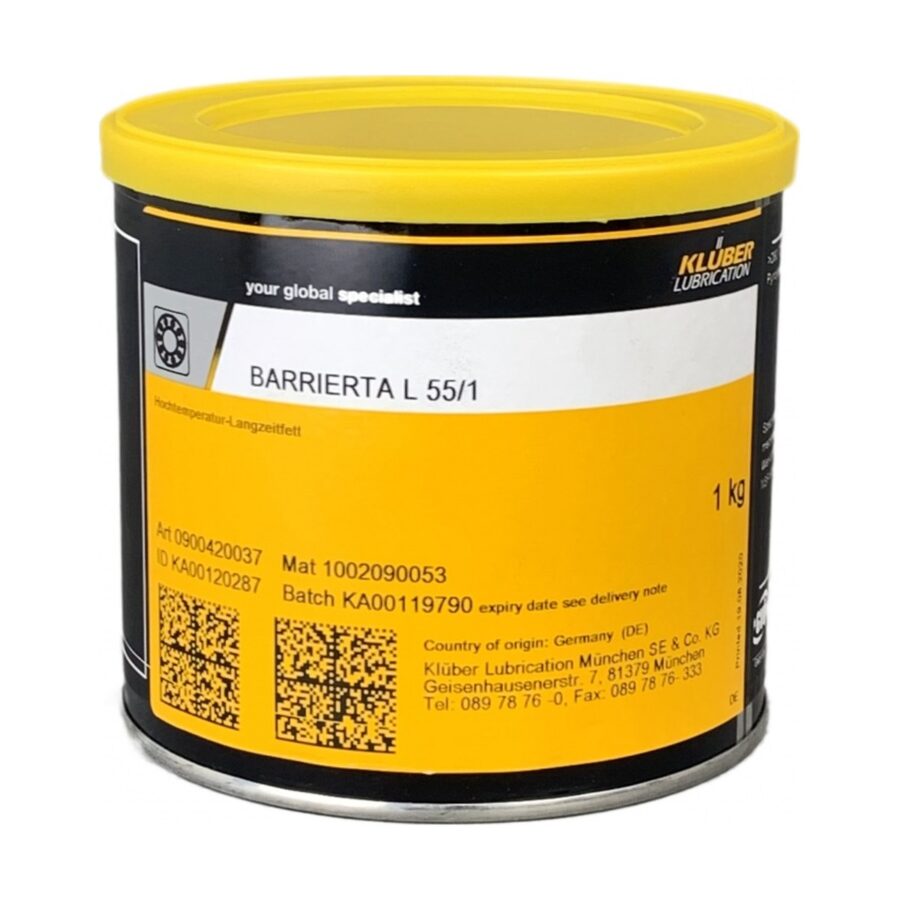
The BARRIERTA L 55 grades
| Grade | Consistency | Typical use | Packs we list |
|---|---|---|---|
| BARRIERTA L 55/0 | Soft | Central lubrication systems, small bearings, application by brush or oiler | 1 kg |
| BARRIERTA L 55/1 | Medium | General rolling and plain bearings | 180 g, 800 g, 1 kg, 10 kg |
| BARRIERTA L 55/2 | Firmer | Rolling bearings, sealing against contamination, vertical shafts | 100 g, 180 g, 800 g, 1 kg, 10 kg |
Choose the consistency to suit the application method and sealing needs, just as you would with NLGI grades. We also list BARRIERTA KM 192 and BARRIERTA I MI-202 for specific applications; check their data sheets.
Why PFPE?
PFPE oils are fully fluorinated polymers. The carbon–fluorine bond is one of the strongest in chemistry, which explains their properties:
- Very high resistance to oxidation and thermal breakdown.
- Very low evaporation at high temperatures.
- No carbon or lacquer deposits: when PFPE does break down at extreme temperatures, it leaves no carbon residue.
- Non-flammable in normal service conditions.
- Chemically inert to most acids, alkalis, solvents, steam and oxygen.
- Insoluble in water and in most solvents.
These properties allow very long relubrication intervals, or lifetime fills, in hot equipment where other greases would need frequent top-ups.
Where is BARRIERTA L 55 used?
| Industry | Typical points |
|---|---|
| Cement, lime and minerals | Kiln auxiliary bearings, hot fans, clinker cooler equipment |
| Textile | Tenter frame chain and bearings, heat-setting machines |
| Plastics and film | Stretching lines, hot rollers |
| Food and feed | Oven and dryer bearings (NSF H1 for the grades stated) |
| Chemicals | Bearings and valves exposed to aggressive media |
| Automotive and paint shops | Oven conveyors, drying tunnels |
| Glass and ceramics | Kiln car and roller bearings |
According to the product data, BARRIERTA L 55/0–3 are NSF H1 registered. See food-grade grease for high temperatures for food plants.
Temperature range
BARRIERTA L 55 grades are rated for continuous service well above 200 °C according to their product data, and for short peaks above that. The exact upper and lower limits differ between grades, so check the data sheet of the grade you use. At the low end, PFPE greases become stiffer than some synthetic hydrocarbon greases, so check starting torque for equipment that starts cold.
Lifetime lubrication with PFPE
Because PFPE greases resist oxidation and evaporation so well, they are often used as lifetime fills: the bearing is filled once at assembly and never relubricated. This is valuable for bearings that are hard to reach, such as those inside ovens, on kiln cars or high on tenter frames, and for sealed bearings where relubrication is not possible. For lifetime fills to work, the bearing must be clean at assembly, the fill must be correct, and the seals must keep contaminants out. Bearing manufacturers and specialist rebuilders often supply bearings pre-filled with PFPE greases for these duties.
BARRIERTA in hot GCC plants
High ambient temperatures in the GCC push many bearings close to the limits of conventional greases, even before process heat is added. Kiln auxiliary bearings in cement plants, conveyor bearings in aluminium smelters, hot fans in power plants and oven bearings in food plants are typical candidates for PFPE greases. In these plants, technicians often have to work in extreme heat to relubricate bearings; extending intervals with a PFPE grease also improves safety by reducing exposure to hot, high locations.
Switching to BARRIERTA correctly
- Remove all old grease: PFPE greases are not miscible with conventional greases, and residues will carbonise at high temperature.
- Clean the bearing with a suitable solvent and let it dry completely.
- Apply BARRIERTA in the quantity the bearing needs; do not overfill.
- Remember that PFPE is about twice as dense as conventional grease, so measure fills by volume.
- Label the point clearly so nobody adds a different grease.
- Use a dedicated grease gun or applicator.
Cleaning before and after
Conventional solvents dissolve the old mineral or synthetic grease but not PFPE. To remove old BARRIERTA from a bearing before refilling, special fluorinated cleaning fluids are used, or the bearing is cleaned mechanically. Ask us about cleaning options before a changeover. In many cases, a thorough mechanical clean followed by a fresh fill is enough.
When should you choose BARRIERTA over other high-temperature greases?
Not every hot bearing needs a PFPE grease. Polyurea greases such as PETAMO and synthetic lithium complex greases cover many applications up to their rated limits at lower cost. BARRIERTA becomes the better choice when temperatures exceed those limits, when chemicals or steam attack conventional greases, when carbon deposits cause problems, or when relubrication is so difficult that a lifetime fill is worth paying for. Compare measured temperatures with each data sheet and calculate the cost per point per year before deciding.
Cost of ownership
| Cost element | Conventional grease in hot service | BARRIERTA L 55 |
|---|---|---|
| Price per kg | Low | High |
| Relubrication frequency | Often weekly or monthly | Much longer, or lifetime |
| Labour and access | Frequent, often in hot or difficult locations | Rare |
| Bearing failures | More frequent | Fewer |
| Deposits and cleaning | Carbon and lacquer build-up | No carbon deposits |
Compare the total annual cost per lubrication point, not the price per kilogram.
Application tips
- Fill new or cleaned bearings to about a third of the free space unless the maker specifies otherwise.
- For relubrication, apply small amounts and let excess escape through seals or vents.
- Keep the grease clean: PFPE greases are often used for lifetime fills, so contamination at assembly lasts for the life of the bearing.
- Do not heat PFPE greases far beyond their rated limits: at extreme temperatures, PFPE decomposition products can be hazardous. Follow the SDS.
Safety
PFPE greases are stable in normal service, but at very high temperatures, well above their service limits, decomposition can release harmful fluorinated gases. Do not smoke while handling them, wash hands after use, and follow the safety data sheet. Avoid exposing them to open flames, for example when removing bearings with a torch.
Inspecting PFPE-lubricated bearings
PFPE greases are usually white or off-white and stay clean-looking for a long time. During inspections, look for darkening, which can indicate contamination or wear particles, and for hardening or dryness at the seals. Monitor housing temperature and vibration trends: a rising temperature on a lifetime-filled bearing is often the first sign that the grease or the bearing is reaching the end of its life. Record findings so intervals can be adjusted with evidence.
A worked example: a textile tenter frame
A textile finishing mill in Dubai relubricates the chain and bearings of a tenter frame weekly with a high-temperature mineral grease. Carbon deposits build up on the chain and drop onto fabric, causing rejects. The mill cleans the bearings completely and switches to BARRIERTA L 55/2, applied by a dedicated grease gun. Relubrication moves to a much longer interval set by inspection, carbon deposits stop, and fabric rejects from lubricant spots fall sharply. Although the grease costs more per kilogram, the annual cost of lubrication, labour and rejects falls.
What are the most common mistakes?
- Topping up with conventional grease.
- Not cleaning out old grease before switching.
- Filling bearings completely: PFPE is dense and over-filling causes heat.
- Assuming all PFPE greases are interchangeable.
- Heating bearings with a torch while PFPE grease is present.
Frequently asked questions
Can I top up BARRIERTA with a normal grease?
No. PFPE greases must not be mixed with conventional greases; clean out completely when changing.
Why is PFPE grease so expensive?
The base oils are costly to produce. In hot applications, its much longer life and fewer failures usually make it the more economical choice.
Which grade should I choose?
BARRIERTA L 55/2 is the most common choice for rolling bearings; L 55/1 or L 55/0 suit softer-grease needs and central systems.
Is BARRIERTA L 55 food-grade?
According to the product data, BARRIERTA L 55/0–3 are NSF H1 registered. Check the data sheet for the exact grade.
Is BARRIERTA water resistant?
PFPE greases are insoluble in water and resist steam. Check the data sheet for water resistance test results.
How long does BARRIERTA last in a bearing?
It depends on temperature, speed, load and contamination. In many hot applications, intervals are much longer than with conventional greases, and some bearings run on a lifetime fill. Set intervals from experience and monitoring.
Conclusion
BARRIERTA L 55 solves lubrication problems where heat, chemicals or long intervals defeat conventional greases. Choose the consistency to suit the application, clean out old grease completely, fill carefully by volume, and compare total cost rather than price per kilogram. See BARRIERTA products and pack sizes and choosing high-temperature grease.
Need help applying this to your plant? Send us the equipment details or the product you use now and we will recommend a suitable Kluber or Mobil grade: request a quote and we reply within one business day.