Key takeaways
- Hot points in food plants need lubricants that are both NSF H1 registered and rated for the real operating temperature.
- PFPE (perfluoropolyether) greases offer the widest temperature range and leave no carbon deposits.
- Measure actual bearing and chain temperatures, including the hottest zone, before choosing a product.
- PFPE greases do not mix with conventional greases: clean bearings thoroughly before changing over.
- Small, frequent amounts beat large, infrequent ones on hot chains and bearings.
Bakeries, snack lines, confectionery plants and other food factories run ovens, fryers, dryers, roasters and sterilisers where bearings and chains get very hot, and the lubricant must still be NSF H1 registered. That combination narrows the choice. Conventional H1 greases often soften, oxidise, bleed oil or carbonise at these temperatures, which leads to short relubrication intervals, smoke, deposits and bearing failures. This guide explains how to choose and use high-temperature food-grade lubricants.
Typical hot points in food plants
| Equipment | Lubrication points | Typical challenge |
|---|---|---|
| Tunnel and rack ovens | Conveyor bearings, chains, drive shafts | Continuous high temperature, smoke, deposits |
| Fryers | Conveyor bearings and chains | Heat plus oil and steam |
| Dryers and coolers | Fan bearings, conveyor bearings | High temperature and speed |
| Roasters | Drum bearings, drives | High temperature and dust |
| Sterilisers and retorts | Door mechanisms, bearings, valves | Steam, pressure and heat |
| Shrink tunnels and sealers | Conveyor bearings and chains | Local hot spots near heaters |
What happens when grease is too hot?
- The base oil evaporates, leaving dry thickener behind.
- Oxidation speeds up, roughly doubling for each 10 °C rise, so grease life falls quickly.
- Mineral oil greases form carbon and lacquer deposits that block bearings and chains.
- Grease softens and runs out of the bearing, or hardens and stops lubricating.
- Smoke and odour appear, which is unacceptable near food.
Our guide to high-temperature grease for kilns, ovens and dryers covers the general principles; this article focuses on food plants.
Types of high-temperature food-grade lubricants
| Type | Typical strengths | Typical use |
|---|---|---|
| Synthetic hydrocarbon (PAO) H1 greases | Good general performance, moderate high-temperature capability | Warm bearings, general food machinery |
| Synthetic ester or PAO H1 greases with high-temperature thickeners | Higher temperature limits, longer life | Dryer fans, hot conveyor bearings |
| PFPE/PTFE H1 greases | Very high temperature limits, chemically inert, no carbon deposits | Oven bearings, hottest zones, long intervals |
| Synthetic H1 high-temperature chain oils | Penetrate chain links, low residue | Oven and fryer chains |
What are PFPE greases?
PFPE greases use a perfluoropolyether base oil, usually thickened with PTFE. The fluorinated chemistry is extremely stable: it resists oxidation, does not burn or carbonise in normal service, and is inert to most chemicals, steam and water. Several PFPE greases carry NSF H1 registration, according to their product data, and some are rated for continuous service well above 200 °C. They cost more per kilogram than conventional greases, but very long relubrication intervals, fewer failures and cleaner ovens often make them the cheaper option overall.
PFPE greases are also very dense, so a given volume weighs much more than the same volume of conventional grease. Plan quantities by volume, not weight, when converting relubrication amounts. Ask us for help converting your current grease quantities and intervals before the changeover.
Products in our range
| Product | Type | Notes from product data |
|---|---|---|
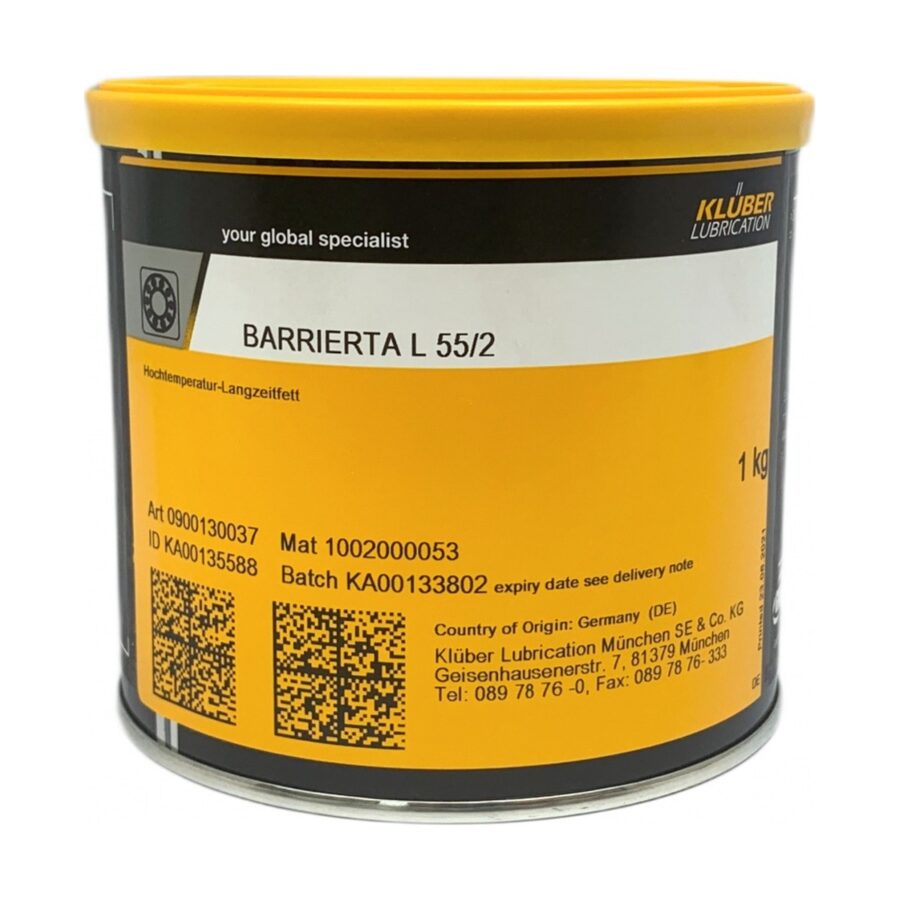
| Kluber BARRIERTA L 55/2 | PFPE/PTFE grease | High-temperature, long-life grease; NSF H1 for the grades stated |
| Klubertemp GR AR 555 | PFPE/PTFE grease | High-temperature grease with NSF H1 registration per product data |
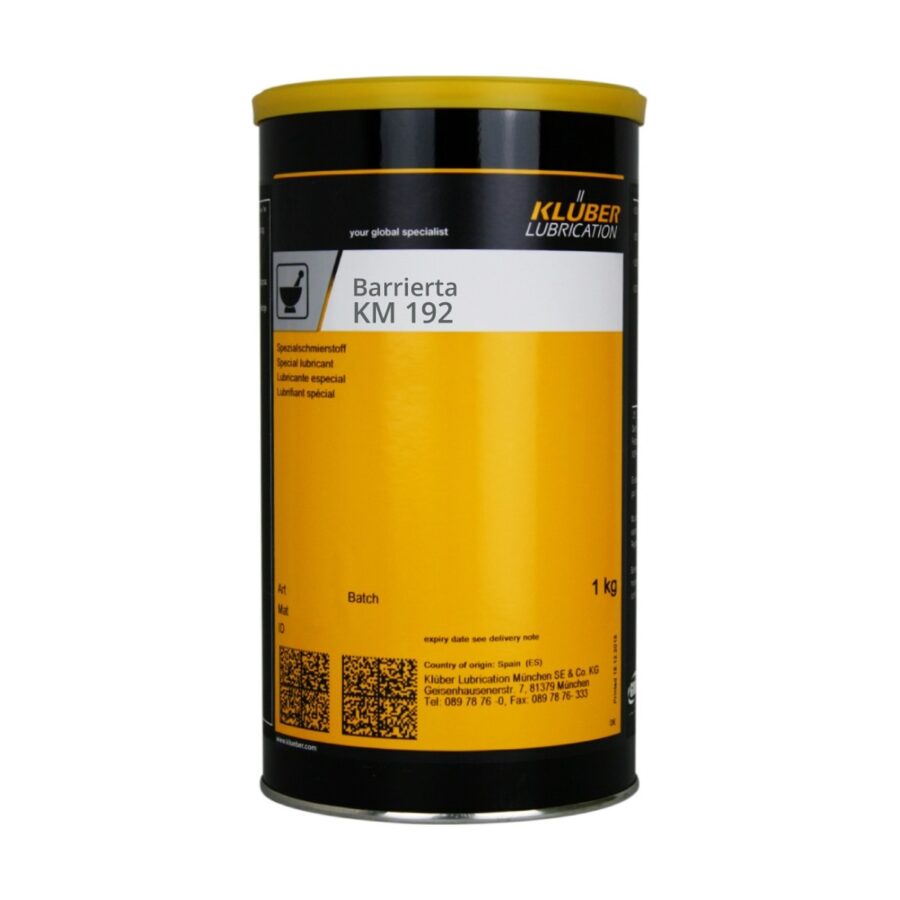
| Kluberalfa BF 83-102 | PFPE-based bearing grease | For high temperatures and speeds; check H1 status for the grade |
| Klubersynth UH1 14-1600 | Synthetic H1 grease | For food-processing bearings at warm, not extreme, temperatures |
Always check the individual product page and data sheet for the upper service temperature and the NSF registration of the exact grade. Browse our food-grade range and high-temperature greases, or filter by temperature with the lubricant finder.
How do you choose a food-grade high-temperature grease?
- Measure the real operating temperature of each bearing and chain with a contact thermometer or infrared camera, including the hottest zone and start-up conditions.
- Add a safety margin: choose a product whose upper service temperature is comfortably above the highest measured temperature.
- Check speed: high-speed fan bearings need a grease rated for the speed factor (n·dm).
- Check load and water or steam exposure.
- Confirm NSF H1 registration for the exact grade, and Halal or Kosher status if required.
- Compare total cost: price, relubrication interval, labour and downtime.
Changing over to a PFPE grease
PFPE greases do not mix well with conventional greases. Residues of mineral or synthetic hydrocarbon grease left in a bearing will carbonise at high temperature and reduce the benefit of the PFPE grease. For the best result:
- Remove the bearing where practical, or flush it thoroughly in place.
- Clean out old grease with a suitable solvent and dry the bearing.
- Fill with the PFPE grease to the recommended level, typically a third to half of the free space.
- Label the point clearly so that only the PFPE grease is used in future.
- Use a dedicated grease gun for the PFPE grease.
Where cleaning is impossible, purge with fresh PFPE grease until clean grease appears, and expect the first interval to be shorter.
Lubricating oven chains
Oven chains run through the hottest zones and need a lubricant that penetrates the pins and bushes, then leaves little residue. High-temperature synthetic H1 chain oils are often better than greases here. Apply small amounts often, ideally with an automatic oiler that delivers the lubricant to the pin and bush area rather than spraying the outer plates. Clean the chain before changing lubricants, and avoid over-lubricating: excess oil drips, smokes and builds deposits.
Relubrication tips for hot bearings
- Relubricate in small amounts more often rather than large amounts rarely.
- Never over-fill hot bearings: excess grease raises temperature through churning.
- Make sure seals and vents let used grease escape away from product.
- Record temperatures over time: a rising trend often shows lubrication problems before failure.
- Use automatic lubricators where access is difficult or hot, and choose models rated for the temperature.
Steam, washdown and sterilisers
Some hot points are also wet. Sterilisers, retorts, blanchers and steam peelers combine high temperature with steam and condensate, and many food lines are washed down daily with hot water and cleaning chemicals. Here the grease must resist water washout and steam, protect against corrosion, and stay in place after cleaning. PFPE greases perform well because steam and most cleaning chemicals do not attack them. Where a PFPE grease is not needed for temperature alone, an H1 grease with a complex thickener and good water resistance may be the more economical choice. Check the water washout and corrosion tests on the data sheet, keep seals in good condition, and relubricate after intensive washdowns if the procedure requires it.
A worked example: a bakery tunnel oven
A bakery in Abu Dhabi relubricates its tunnel oven conveyor bearings every week with a conventional H1 grease, and still replaces several bearings a month. Smoke is visible near the hottest zone. Temperature measurements show the bearings in that zone run well above the grease’s rated limit. The bearings in the hot zone are cleaned and refilled with an NSF H1 PFPE grease, and the chain is switched to a synthetic H1 high-temperature chain oil applied by an automatic oiler. Relubrication moves from weekly to a much longer interval set by monitoring, bearing replacements fall sharply and the smoke disappears.
What are the most common mistakes?
- Choosing grease by the oven setting rather than the measured bearing temperature.
- Mixing PFPE grease with conventional grease without cleaning.
- Using too much grease or chain oil.
- Assuming any high-temperature grease is H1 registered.
- Ignoring speed limits on fan and dryer bearings.
Frequently asked questions
Can food-grade grease work above 200 °C?
Yes, some NSF H1 PFPE greases are rated for very high temperatures. Check the upper service temperature on the data sheet.
Why does my oven chain smoke?
Usually the lubricant is evaporating or burning at that temperature, or too much is applied. A lubricant rated for the temperature, applied sparingly, reduces smoke and deposits.
Is PFPE grease worth the higher price?
Often yes in hot zones, because much longer intervals, fewer bearing failures and cleaner equipment outweigh the higher price per kilogram.
Can I mix PFPE grease with my current grease?
It is not recommended. Clean out the old grease before changing over to get the full benefit.
How do I measure bearing temperature in an oven?
Use a contact thermometer or infrared camera on the bearing housing during normal production, and record the highest value across the oven.
Do automatic lubricators work in hot zones?
Yes, if the lubricator is rated for the ambient temperature. Many are mounted outside the hottest area and connected to the bearing with a feed line, which protects the unit and keeps refills easy.
Conclusion
Hot points in food plants need lubricants that are both NSF H1 registered and truly rated for the temperature. Measure the real temperatures, choose with a safety margin, consider PFPE greases for the hottest zones and synthetic H1 chain oils for oven chains, clean out old grease when changing over, and apply small amounts often. The result is fewer failures, less smoke and cleaner, safer production.
Need help applying this to your plant? Send us the equipment details or the product you use now and we will recommend a suitable Kluber or Mobil grade: request a quote and we reply within one business day.