Key takeaways
- Cement plants combine the three hardest conditions for lubricants: heat, heavy loads and abrasive dust.
- Girth gears on kilns and mills need adhesive open-gear lubricants applied by spray systems, with a planned running-in.
- Large enclosed gearboxes on mills, kilns and crushers often justify synthetic gear oils and oil analysis.
- Contamination control (seals, breathers, clean handling) prevents more failures than any single product.
- Hot bearings on coolers, fans and kiln auxiliaries need greases rated for the measured temperature.
A cement plant runs some of the largest and most heavily loaded machines in industry: rotary kilns several metres in diameter, ball mills and vertical roller mills with megawatt drives, crushers handling limestone and clinker, and kilometres of conveyors and elevators. All of them run in heat and abrasive dust, often continuously for months between shutdowns. Lubrication is one of the main levers for reliability. This guide works through the plant from quarry to cement mill and explains how to lubricate each area. See also our cement and mining industry page.
Why are cement plants hard on lubricants?
| Condition | Effect on lubrication | Response |
|---|---|---|
| Abrasive dust (limestone, raw meal, clinker, cement) | Abrasive wear of bearings and gears; contaminated oil and grease | Seals, breathers, filtration, purging relubrication |
| High temperatures near kiln and cooler | Oxidation, carbonisation, short grease life | High-temperature greases, synthetic oils |
| Very heavy, slow loads (kiln, mills) | Boundary lubrication, scuffing, pitting | High viscosity, EP additives, solid lubricants |
| Shock loads (crushers) | Bearing and gear damage | EP greases and oils, correct viscosity |
| Continuous operation | Little time for maintenance | Long-life lubricants, automatic systems, condition monitoring |
| GCC ambient heat (often 45 °C+) | Higher operating temperatures everywhere | Margin on temperature ratings, cooling, synthetic products |
Quarry and crushing
Primary crushers (jaw, gyratory or impact) and secondary crushers carry heavy shock loads in a very dusty environment. Grease-lubricated crusher bearings need an EP grease with high base-oil viscosity and good adhesion, applied often enough to purge dust from the seals. Larger crushers with circulating oil systems need a clean, correctly graded EP oil with good filtration. Mobile quarry equipment adds hydraulics and gearboxes, where dust ingress through breathers is a common cause of failures.
- Use an EP grease with high base-oil viscosity for slow, heavily loaded crusher bearings.
- Relubricate small amounts frequently to keep seals full and push out dust.
- Fit desiccant or filter breathers on gearboxes and hydraulic tanks.
- Keep grease nipples capped and clean them before greasing.
Raw mills and vertical roller mills
Vertical roller mills (VRMs) have a large main gearbox under the grinding table, usually with a forced-circulation oil system, plus grinding roller bearings that may be oil- or grease-lubricated. The main gearbox is one of the most critical and expensive components in the plant. Most VRM gearbox makers specify high-performance EP gear oils, often ISO VG 320, in mineral or synthetic versions. Oil cleanliness, temperature control and oil analysis are essential. Grinding roller bearings work under very high loads and temperatures and need lubricants approved by the mill maker.
The rotary kiln
The kiln is the heart of the plant. Its lubrication points include the girth gear and pinion, the main drive gearbox, the support roller (tyre roller) bearings, the thrust rollers, the tyre and filler bar interface, and the kiln inlet and outlet seals.
| Point | Typical lubricant | Notes |
|---|---|---|
| Girth gear and pinion | Adhesive open-gear lubricant (e.g. GRAFLOSCON) | Spray system, planned running-in |
| Main drive gearbox | EP gear oil, often ISO VG 320–680; synthetic for hot drives | Oil analysis, breathers |
| Support roller bearings | High-viscosity oil bath or grease per maker | Heat from the kiln shell; watch temperature |
| Thrust rollers | Grease or oil per maker | Heavy loads |
| Tyre / filler bars | High-temperature dry or paste lubricants per maker | Reduces wear and migration |
| Auxiliary drive and couplings | EP grease or gear oil | Often neglected |
Girth gears and open gears
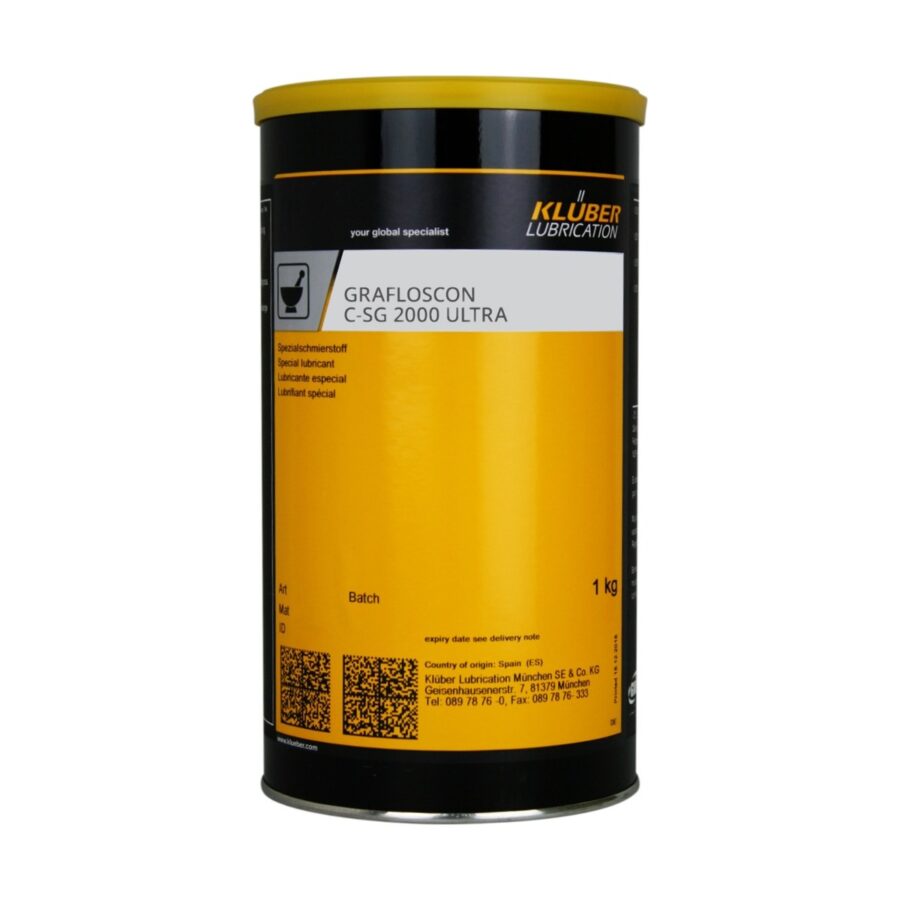
Girth gears on kilns and ball mills are large open gears that cannot be oil-bath lubricated. They need adhesive lubricants that stay on the teeth, carry very high loads and resist being thrown off. Kluber GRAFLOSCON products, such as GRAFLOSCON C-SG 2000 ULTRA in our catalogue, are designed for these gears and are normally applied by an automatic spray system that delivers small amounts at regular intervals.
Many open-gear makers and lubricant suppliers recommend a three-stage approach for new or refurbished gears: a priming lubricant applied before start-up, a running-in lubricant that helps the tooth surfaces bed in and smooths contact patterns, and then the operational lubricant. Follow the gear maker’s and the lubricant supplier’s programme, and inspect contact patterns with thermography and visual checks during running-in.
- Check spray nozzles regularly: blocked nozzles cause dry areas and tooth damage.
- Use thermography to check the temperature profile across the tooth face; hot spots show misalignment or lubrication gaps.
- Adjust the spray quantity to keep a thin, even film without heavy build-up.
- Keep the gear guard sealed to keep dust out.
Kiln support roller bearings
Support roller bearings carry the weight of the kiln and run hot because of radiant heat from the shell. Many are plain bearings in oil baths, using high-viscosity oils; others use rolling bearings with oil or grease. Rising bearing temperatures are a warning sign, often caused by misalignment, contaminated oil or insufficient oil. Keep oil levels correct, sample oil regularly, and keep cooling water systems working where fitted.
Clinker cooler
Grate cooler drives, hammer crushers and fans at the cooler run in high heat and clinker dust. Bearings near the hot zone often need high-temperature greases such as Klubersynth BH 72-422, PETAMO or, in the hottest locations, PFPE greases such as BARRIERTA L 55. Measure actual bearing temperatures before choosing. See high-temperature grease for kilns, ovens and dryers.
Cement mills (ball mills)
Ball mills have a girth gear and pinion (or a central drive gearbox), trunnion bearings and auxiliary drives. Trunnion bearings are large plain bearings with oil lubrication and often hydrostatic lifting at start-up; they need clean oil of the viscosity specified by the mill maker. The girth gear is lubricated as described above. The mill main gearbox, where fitted, needs a high-quality EP gear oil and close condition monitoring.
Fans
Kiln ID fans, cooler fans, mill fans and bag filter fans are large, fast machines. Their bearings are oil- or grease-lubricated. Fans handling hot gas need greases or oils rated for the temperature; dust-laden fans can suffer imbalance and vibration that damage bearings. Combine correct lubrication with vibration monitoring.
Conveyors, bucket elevators and apron feeders
- Conveyor pulley and idler bearings: EP greases with good sealing; purging relubrication in dusty areas.
- Bucket elevator head drives: EP gear oil or synthetic gear oil in hot locations; chains with suitable chain lubricants.
- Apron feeders and pan conveyors: heavily loaded rollers and chains, often near hot material.
- Screw conveyors: hanger bearings in dust; consider sealed or lubricant-free designs where possible.
Main gearboxes: mineral or synthetic?
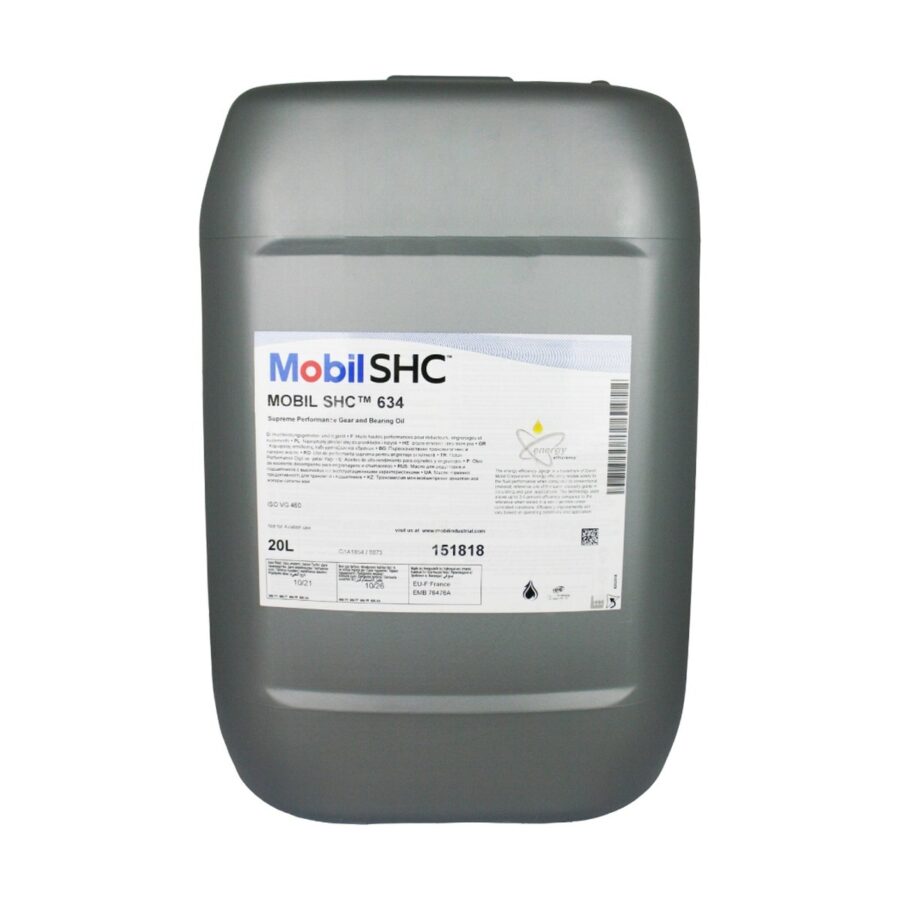
Large kiln, mill and crusher gearboxes often hold hundreds of litres of oil. Synthetic PAO gear oils such as Mobil SHC 632 or SHC 634 keep their viscosity better at high temperatures, last much longer and can reduce operating temperatures. For hot, critical gearboxes, the higher oil price is often recovered by longer drain intervals and fewer failures. See Mobil SHC 600 vs Mobilgear 600 XP.
Contamination control
Dust is the biggest enemy in a cement plant. Most bearing and gear failures can be traced back to contamination. Practical measures:
- Desiccant or filter breathers on every gearbox, hydraulic tank and oil reservoir.
- Seals in good condition; labyrinth or taconite seals on bearings in very dusty areas.
- Closed, labelled containers and clean transfer equipment for oils and greases.
- Filtration of new oil before filling critical gearboxes and hydraulic systems.
- Grease nipples capped and wiped before every relubrication.
- Silicon (dust) tracked in oil analysis as a key indicator.
Oil analysis and condition monitoring
Oil analysis on main gearboxes, kiln support roller bearings, VRM gearboxes and hydraulics catches problems early. Track viscosity, water, oxidation, wear metals (iron, copper) and silicon. Combine with vibration analysis and thermography for a complete picture. See oil analysis basics.
A worked example: a kiln girth gear
A cement plant in the UAE notices rising temperatures at one end of the kiln girth gear during thermography checks. Inspection shows partly blocked spray nozzles and a thick build-up of old lubricant on the teeth. The team cleans the nozzles, adjusts the spray quantity, removes the heavy deposits during the next stop and introduces a weekly nozzle check and monthly thermography. The temperature profile across the tooth face evens out and the contact pattern improves.
What are the most common mistakes?
- Neglecting spray nozzle checks on girth gears.
- Using plain vents instead of breathers on gearboxes.
- Choosing high-temperature greases by process temperature rather than measured bearing temperature.
- Over-greasing fan bearings.
- Leaving lubricant containers open in dusty areas.
Frequently asked questions
What is the biggest lubrication risk in cement plants?
Contamination by dust. Good sealing, clean lubricant handling and correct relubrication intervals prevent most bearing failures.
Which lubricant for kiln girth gears?
An adhesive open-gear lubricant designed for large girth gears, such as GRAFLOSCON, applied by an automatic spray system.
Is synthetic gear oil worth it for cement mill gearboxes?
Often yes for large, hot or critical gearboxes, thanks to longer oil life and better high-temperature performance. Use oil analysis to manage intervals.
How often should crusher bearings be greased?
Frequently, with small amounts, to keep seals full and purge dust. Follow the maker’s intervals and adjust with experience.
Which grease for clinker cooler bearings?
A high-temperature grease rated for the measured bearing temperature; PFPE greases for the hottest points.
Conclusion
Cement plant lubrication is about heat, heavy loads and dust. Use adhesive open-gear lubricants with well-maintained spray systems on girth gears, high-quality or synthetic gear oils on main drives, high-temperature greases rated for measured temperatures, and strict contamination control everywhere. Browse our extreme-pressure greases, gear oils and high-temperature greases.
Need help applying this to your plant? Send us the equipment details or the product you use now and we will recommend a suitable Kluber or Mobil grade: request a quote and we reply within one business day.